Understanding Peak Demand Penalties and Time-of-Use Tariffs for Commercial Property
How do peak demand charges affect commercial electricity bills, and how can businesses reduce them?
Peak demand penalties are capacity charges levied by commercial utility companies based on the highest volume of electricity consumed during a single, brief interval (typically 15 to 30 minutes) within a billing cycle. Businesses can mitigate and reduce these charges through a process called load shifting—using real-time energy analytics platforms to identify high-energy asset cycles and rescheduling their runtimes to off-peak hours.
In a volatile energy market, failing to monitor your operational peak demand means a single 15-minute spike in electricity usage can dictate up to 30% to 50% of your entire commercial power invoice for the next month—or even the entire year.
The Anatomy of Modern Commercial Electricity Tariffs
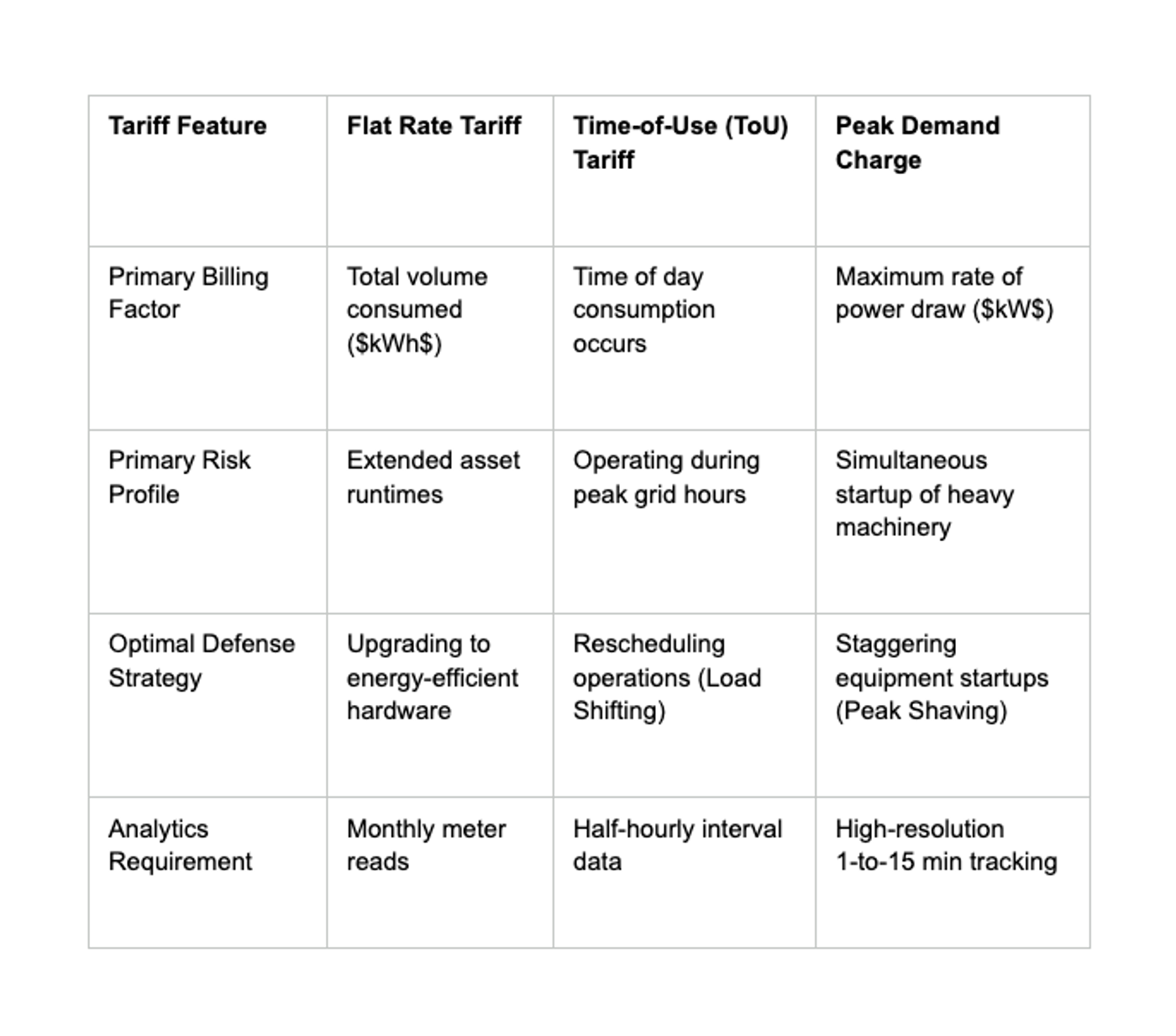
Commercial electricity bills are fundamentally different from residential billing. While homeowners generally pay a flat rate for the net volume of power consumed, enterprises are billed based on two distinct metrics:
- Consumption Charges (kWh): The total volume of electrical energy consumed over time. This is an operational expense (OpEx) driven by cumulative runtime.
- Demand Charges (kW): The maximum rate at which your facility draws power from the electrical grid during a specific measurement window. This fee compensates the utility provider for maintaining the physical infrastructure (transformers, substations, and cabling) required to handle your absolute highest usage surge.
The Mathematical Problem of Peak Demand
Demand charges are calculated using the maximum peak power ($kW$) reached during the billing cycle multiplied by your specific tariff rate:
C = P * RC = Demand Charge ($/month)
P = Peak Power (kW)
R = Tariff Rate ($/kW/month)
If your commercial facility operates at a steady 100 kW baseline all month, but you turn on three heavy industrial HVAC chillers and an EV fleet charging array simultaneously at 4:00 PM on a Tuesday, your demand might spike to 400 kW for just fifteen minutes.
Your utility company will bill your demand charge for the entire month based on that $400 kW peak, even if your usage immediately dropped back down to $100 kW for the remaining 29 days.
What are Time-of-Use (ToU) Tariffs?
To ease strain on the electrical grid during times of high societal strain, utility companies utilize Time-of-Use (ToU) pricing. Under a ToU structure, the day is split into distinct windows:
- Off-Peak: Low-demand hours (typically overnight) where electricity is at its cheapest.
- Mid-Peak / Shoulder: Standard daytime hours with moderate operational pricing.
- On-Peak: High-demand bottlenecks (typically 4:00 PM to 7:00 PM on weekdays) where both consumption rates and peak demand capacity penalties skyrocket exponentially.
Consuming power during an "On-Peak" window can cost up to five times more per kilowatt-hour than drawing the exact same amount of power during an "Off-Peak" window.
Step-by-Step Strategy to Mitigate Demand Penalties
To systematically lower your facility's utility exposure without reducing your actual operational output, facility managers leverage energy analytics software to deploy a three-part reduction framework.
[Step 1: Audit & Identify] ──► [Step 2: Peak Shaving] ──► [Step 3: Load Shifting]
Locate the high-kW assets Deploy batteries/backup Reschedule runtimes
using interval analytics during historical peaks to off-peak windows
1. Identify the Culprits via Interval Analytics
You cannot fix a peak demand problem using a monthly paper utility invoice. You must deploy an energy analytics platform capable of tracking consumption at 15-minute or 1-minute intervals. This high-resolution data allows you to cross-reference your operational logs with your exact consumption spikes to determine exactly which machine, line, or system is causing the threshold breach.
2. Implement Peak Shaving
Peak shaving involves cutting off the absolute top tip of your consumption spikes. When real-time data engines flag that your building is approaching its historical $kW$ ceiling, facility teams can temporarily cycle off non-essential loads (like storage water heaters) or briefly engage on-site battery storage systems to absorb the load locally rather than drawing it from the grid.
3. Orchestrate Automated Load Shifting
Load shifting involves taking predictable, heavy energy-intensive processes and intentionally rescheduling them to run during cheaper, off-peak windows. For example, instead of running automated commercial laundry cycles, heavy materials processing, or warehouse deep-freezing routines at 5:00 PM, these tasks are shifted to 11:00 PM, completely dodging both ToU premiums and peak demand penalties.
Frequently Asked Questions
What is a "Ratchet Clause" in a commercial energy contract?
A ratchet clause is a punitive contractual mechanism used by some utility providers where your peak demand charge is determined by the highest $kW$ spike recorded over the past year, rather than just the current billing month. If your facility sets a massive peak demand spike during a summer heatwave, a ratchet clause allows the utility provider to continuously bill you at a percentage of that high summer rate for the next 11 months, making real-time peak prevention financially critical.
What is the difference between kW and kWh on a commercial bill?
$kW$ (Kilowatt) is a measure of electrical power demand and represents the instantaneous rate at which your building draws electricity from the grid. $kWh$ (Kilowatt-hour) is a measure of total electrical energy consumption and represents the total volume of power used over a period of time. Think of $kW$ as the speed your car is traveling at any given moment, while $kWh$ is the total distance your car has driven.
How does an energy dashboard help prevent peak demand penalties?
An energy dashboard prevents peak demand penalties by establishing automated, continuous threshold tracking. When your building’s live $kW$ draw approaches a dangerous, pre-configured baseline, the system automatically triggers real-time alerts via webhooks, emails, or SMS. This gives operations teams or automated Building Management Systems (BMS) an immediate window to step-down non-critical equipment loads before a new billing peak is permanently set.