Smart Meters vs. Analogue Meters: What's Actually the Difference?
Smart meters and analogue meters both measure electricity, but the similarities end there. Here's what actually changes, and why it matters more than most businesses realise.

Smart meters and analogue meters both measure electricity, but the similarities end there. Here's what actually changes, and why it matters more than most businesses realise.
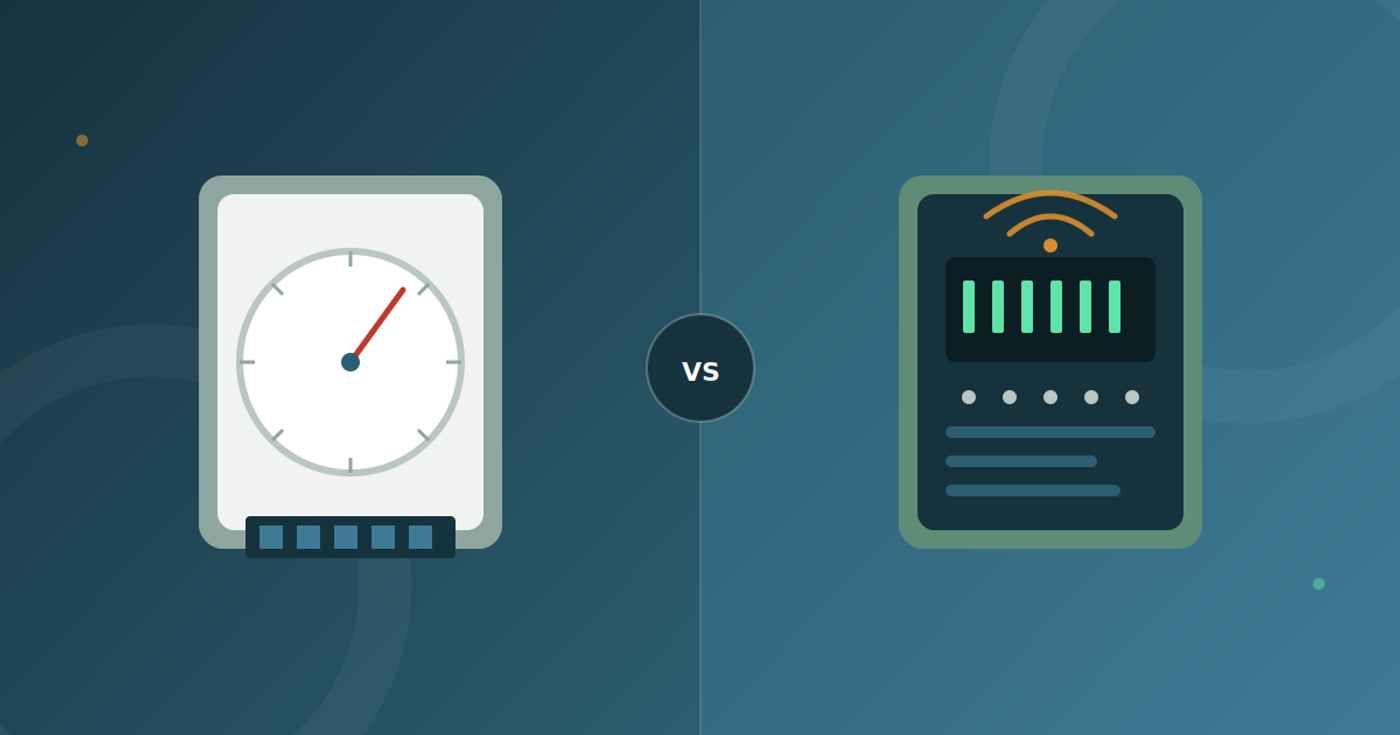
If your mental image of a "meter" is still a dial with a spinning disc that someone has to physically walk up to and read, you're not picturing something outdated for effect. For a lot of buildings, that's still exactly what's bolted to the wall.
Smart meters have been rolling out for years now, and most people know the name without really knowing what changed. So here's the actual difference: not the marketing version, the practical one.
An analogue meter is a mechanical device. Electricity flows through it, spins an internal disc or dial at a rate proportional to consumption, and the meter accumulates a single running total. That's it. That's the whole feature set.
To get a reading, someone has to physically look at it, either you, or a meter reader sent by the supplier. Between visits, your bill is typically estimated, based on your historical usage pattern, and corrected later once an actual reading comes in. If your consumption changes significantly between reads (you expand, you cut back, a piece of equipment starts running differently), the estimate drifts further from reality, and you find out weeks or months after the fact.
There's no timestamp data. No breakdown by hour. No way to know whether that total was consumed steadily across the month or in one enormous spike on a Tuesday afternoon. It's a total, full stop.
A smart meter is a digital device that records consumption at regular short intervals, typically every 15 or 30 minutes, and transmits those readings automatically over a network, without anyone needing to visit the meter at all.
That single change unlocks almost everything else:
Here's the part that's easy to miss if you only think of this as "old meter vs. new meter." The real shift isn't really about accuracy. It's about time resolution.
An analogue meter answers one question: how much did you use this month? A smart meter answers a completely different, much more useful question: how much did you use, and when?
That distinction is what makes half-hourly data valuable. It's what lets you see a load profile (the actual shape of your consumption across a day) rather than a single flat number. It's what makes anomaly detection possible at all, since you can't spot an unusual 2am spike in a number that only updates once a month. And it's the entire reason time-of-use tariffs exist: a supplier can only charge you differently for peak versus off-peak consumption if it can actually see when that consumption happened.
Without interval data, none of that works. This is why the shift to smart metering wasn't just an upgrade in accuracy. It was the thing that made an entire category of energy monitoring and analytics possible in the first place.
This is the part that trips people up. Having a smart meter installed does not automatically mean you get detailed usage analytics. The smart meter generates the data, but what happens to that data afterward depends entirely on who's looking at it and how.
In Ireland, for instance, smart meter rollout and ownership sits with ESB Networks, the grid operator, not with individual retail suppliers. Suppliers receive the same underlying interval data from ESB Networks, but plenty of them expose almost none of it to customers directly, often reducing it right back down to a single monthly total on your bill anyway. You can have a smart meter for years and still be looking at what is, functionally, the same flat number an analogue meter would have given you. The capability for detail exists, but nobody's actually showing it to you.
This is the gap that dedicated monitoring and analytics platforms exist to close: pulling the interval data that's already being generated and actually making it visible and useful, rather than letting it sit unused in a supplier's backend.
A few practical takeaways:
The meter on the wall matters less than most people assume. What matters is whether the data it's already generating is actually going anywhere useful.