Base Load vs. Peak Load: What Your Overnight Consumption Actually Reveals
Your overnight energy use should be boring. When it isn't, that's usually the clearest signal available that something's wrong. Here's how to actually read it.

Your overnight energy use should be boring. When it isn't, that's usually the clearest signal available that something's wrong. Here's how to actually read it.
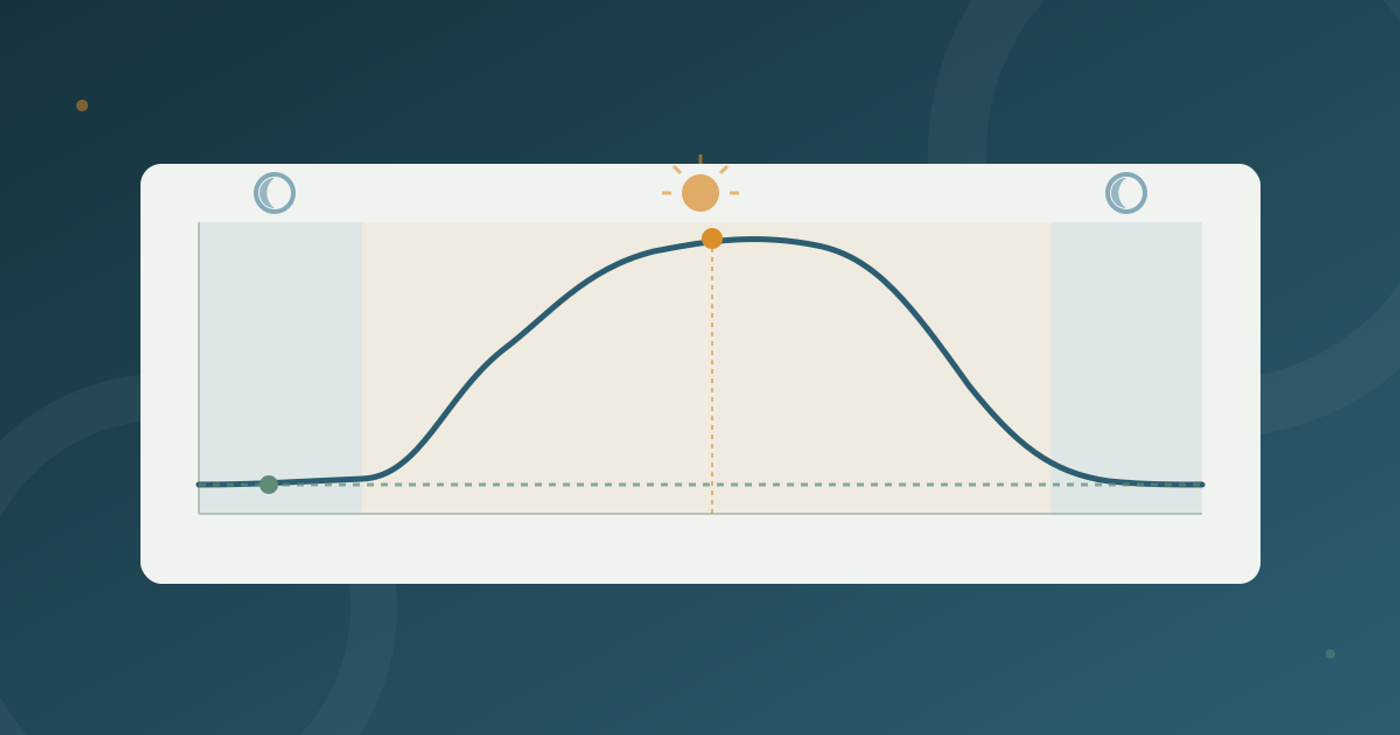
Most people who review their energy usage go straight for the big number, the peak, the busiest hour, the moment demand hits its highest point. That's understandable. It's the dramatic part of the chart.
But if you're looking for where waste is actually hiding, the overnight number is usually more revealing. It's boring by design, and boring is exactly why it works so well as a diagnostic.
Base load is the minimum level of consumption your site uses continuously, the number that never really goes away, even during the quietest hours. Overnight, on weekends, whenever the building should be doing close to nothing.
Base load exists because some things genuinely do need to run all the time. Refrigeration. Servers. Security systems. Standby equipment. A certain amount of continuous draw is completely normal and expected.
The key word there is certain. Base load should be a small, predictable number that roughly matches what you know genuinely needs to run around the clock. When it's higher than that, and especially when it creeps up gradually over time, that's usually not "just how the building runs." That's waste, hiding in the one part of the day nobody's paying attention to.
Peak load is the opposite end: the highest level of demand your site hits, typically during your busiest operating hours. This is the number most commercial tariffs care about directly, since many include a demand or capacity charge tied specifically to your highest moment, not just your total consumption.
Peak load is less about waste and more about timing and capacity. A high peak isn't necessarily a problem on its own, a business that genuinely needs a lot of power during operating hours will have a high peak, and that's expected. The question with peak load is usually whether it's happening efficiently (spread out, predictable) or inefficiently (everything switching on at once, creating an avoidable spike).
Here's the actual reason base load deserves more attention than it usually gets: it's the cleanest signal you have, because it should be simple. During operating hours, energy use is genuinely complicated, it depends on occupancy, weather, production schedules, a dozen legitimate variables that make the number hard to interpret on its own.
Overnight, almost all of that complexity disappears. Nobody's in the building. Nothing should be actively working. Whatever's left on the meter at 3am is either something that's supposed to be running continuously, or something that shouldn't be running at all. There's very little in between, which makes an inflated base load one of the easiest anomalies to actually interpret correctly.
A few of the most common culprits, roughly in order of how often they turn out to be the actual answer:
Equipment left on that should have been switched off. The most straightforward cause, and often the easiest to fix once it's actually noticed.
A schedule that never got updated. HVAC or lighting still running on a timetable that made sense for old operating hours, quietly conditioning or lighting an empty building every night.
A fault that's gradually gotten worse. A compressor or motor that's lost efficiency doesn't announce itself with a dramatic event, it just draws a bit more power continuously, including overnight, and that shows up as a base load that's crept upward over months.
Something that was never supposed to run continuously in the first place, but somehow ended up doing so, a setting changed at some point and nobody caught it.
Pull up your overnight consumption, ideally over several nights, not just one, since a single night could be an anomaly rather than a pattern. Ask two questions:
Peak load deserves its own separate check, but the questions are different. Instead of "is this too high," the more useful question is usually "is this happening efficiently." If your peak is driven by several systems all starting up at the same moment each morning, staggering that startup can genuinely lower your peak, and therefore your demand charges, without reducing how much energy you actually use overall.
This is where the relationship between base load and peak load becomes useful as a single concept rather than two separate numbers: the gap between them, sometimes described in terms of load factor, tells you how consistent your usage is across the day. A big gap between a low base load and a very high peak generally means your usage is concentrated into short, intense bursts. A smaller gap means your usage is more spread out and steady. Neither is automatically better, but knowing which pattern you actually have changes what kind of intervention would help.
Base load and peak load are answering two different questions. Base load asks "is something wasteful running when it shouldn't be." Peak load asks "is our heaviest usage happening as efficiently as it could." Both are worth checking, but if you only have time to look at one number this month, make it the overnight figure. It's the one most likely to be hiding something nobody's noticed yet, precisely because it's the number nobody usually thinks to look at.